Sophia Alchemical Insight
Explore your question through an alchemical journey of transformation, integration, understanding, and renewal.
Your Alchemical Journey
The plate becomes an illuminated correspondence network. A constrained route travels from the upper field through connected regions, with the ending depth changing from journey to journey.
VENITE
VENITE
Your Sophia Alchemical Insight
How the historical alchemical plate becomes a personal journey of transformation
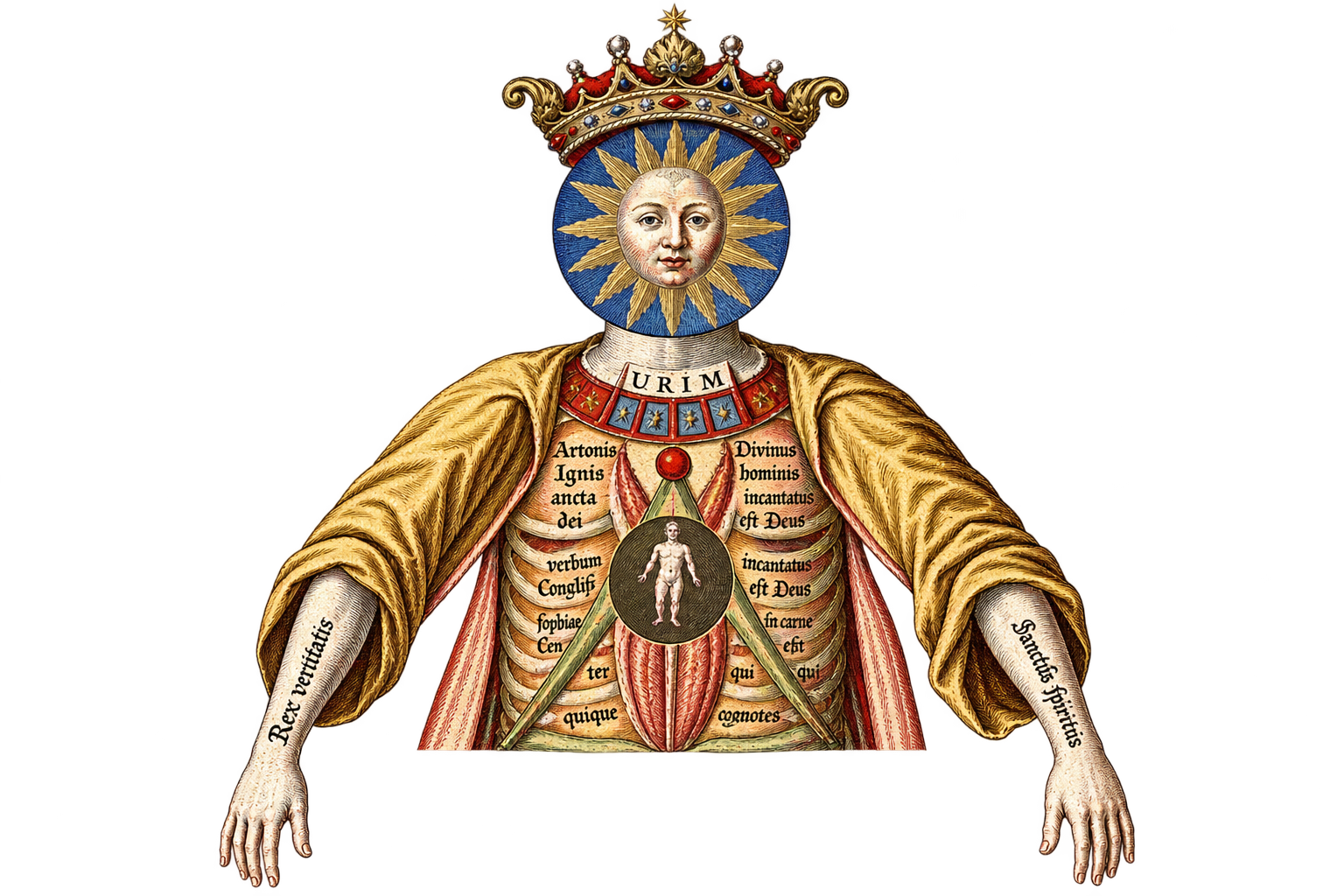
Sophia Alchemical Insight uses a large correspondence map inspired by the Heavenly and Earthly Eve tradition. The plate contains many named emblems arranged from the crown and upper principles through elemental, solar, lunar and alchemical stages into the lower regions of Theoria, Practica and Sylex. Your question sets one constrained route in motion. The route can end at different depths, so each reading follows a different sequence of connected emblems before the final interpretation is prepared.
How to begin
Enter one clear question about something you want to understand, change or integrate. You can ask about a decision, relationship pattern, emotional tension, creative block, personal direction or another situation where the important issue is transformation rather than a simple yes-or-no answer.
Keep the question focused on one theme so the route can be read as one coherent process.
The seven stages of the tool
The interface shows seven stages: Question → Plate Awakening → Graph Draw → Variable Depth → Turning Point → Final Emblem → Interpretation.
These stages describe how the tool moves from your question into the animated plate, selects one connected route, determines how deep that route descends and then brings the journey together in the final reading.
I — Question
Your question gives the reading its subject. The wording does not manually choose the route; instead, it gives context to the interpretation after the path has been drawn.
Questions about change, integration, tension, renewal and direction tend to work especially well with this kind of layered alchemical structure.
II — Plate Awakening
When the journey begins, the whole plate becomes active. Symbols brighten, atmospheric movement increases and the diagram visually shifts from a static historical field into an active reading space.
This stage shows that the tool is still working. It is not yet the final route or interpretation.
III — Graph Draw
The graph selects a legal connected path through the plate. The highlighted route follows the existing relationships between emblems rather than jumping randomly between unrelated points.
Each illuminated step becomes part of the reading and is numbered so you can follow the sequence.
IV — Variable Depth
Not every journey descends to the same level. Some readings end earlier in the middle regions of the plate, while others continue deeper toward the lower alchemical stages.
A shorter path is not less important. It simply means the selected process reaches its turning point sooner.
V — Turning Point
The turning point is where the route changes emphasis. It can mark movement from preparation into transformation, from conflict into integration, or from an upper principle into a more practical or embodied stage.
Pay attention to the emblem around this point because it often explains why the later part of the path develops the way it does.
VI — Final Emblem
The final emblem is the endpoint of the selected route. It becomes more strongly illuminated and acts as the closing image of the journey.
Read it together with the path that led to it. The endpoint becomes much clearer when you understand the earlier stages rather than treating it as a stand-alone answer.
VII — Interpretation
The final interpretation brings the question, route, turning point and final emblem together. It is designed to explain the movement of the process rather than simply list the meanings of every symbol.
After reading it, return to the plate and trace the illuminated sequence once more.
The upper crown
The upper part of the plate contains the crown and higher principles, including Sophia, the Virgin, Architectus and the Sun of Justice. These areas are useful for questions of purpose, orientation, renewal, perception and the organizing principle behind the issue.
Tinctures
Water, Blood, White and Red form one of the early bands of the map. These emblems can be read as different states of transformation: dissolution, vitality, purification and completion or intensification.
When the path moves through several tinctures, pay attention to the order in which they appear.
The five elemental regions
Ignis, Aer, Natura, Aqua and Terra bring the process into elemental form. Fire can emphasize action and ignition; Air thought and movement; Natura organic integration; Water feeling and dissolution; Earth embodiment and practical reality.
Solar and lunar axis
Divine Sun, Man in Equilibrium, Celestial Chimera and Lunar Vessel create one of the central axes of the plate. This region often helps show the relationship between clarity and receptivity, conscious direction and deeper feeling, or integration and polarity.
The seven-fold historical bands
The middle arcs contain groups such as Seven Eagles, Seven Lions, Seven Ravens and Seven Spheres, followed by Dust and Ashes, Anima Spiritus, Philosopher's Gate, Four Elements, Chaos, Quincunx and the Black Sphere.
These regions often represent increasingly complex stages of breakdown, ordering, threshold and reconfiguration.
Nigredo
Nigredo is the darkening stage: breakdown, confrontation with what is no longer working and the recognition of material that needs to be transformed.
If your route reaches this stage, look at what earlier part of the path has prepared the descent.
Albedo
Albedo is associated with clarification, washing, separation and the emergence of a cleaner perspective after confusion or breakdown.
It can point toward simplification, honesty or a need to remove what obscures the central issue.
Citrinitas
Citrinitas marks a stage of increasing illumination and integration. It can represent the point where understanding starts to become usable rather than remaining only internal.
Rubedo
Rubedo is the reddening or completion stage, associated with embodiment, integration and bringing the transformed material into lived reality.
A route that reaches Rubedo may be emphasizing action after understanding.
VITRIOL and Mercurius
VITRIOL points toward inward examination and the search for what is essential beneath the surface. Mercurius represents mediation, movement, exchange and the capacity to hold or connect opposites.
These two can be especially important when the reading concerns contradiction or transformation between two different states.
Sol Rex and Luna Regina
Sol Rex and Luna Regina represent solar and lunar principles in a more developed form: direction and receptivity, clarity and feeling, active and reflective forces.
When both appear in one route, compare their sequence and the emblem that connects them.
Rebis
Rebis occupies the central position of a later band and represents integration of opposing qualities. It is especially relevant when the question involves reconciling two sides of yourself, two needs or two apparently incompatible directions.
Three Crowned Heads and Lunar Phases
These emblems extend the later stages of the plate into questions of multiple perspectives, cyclical development and changing conditions. They can show that integration is not always linear.
Purple Moon, Fons Vitae, World in Hand and Lex
These lower emblems move the journey toward inner depth, renewal, embodiment and order. Fons Vitae emphasizes a source of life or replenishment; World in Hand brings the process toward practical integration; Lex emphasizes structure, law or governing principle.
Phoenix and Solar Child
Phoenix and Solar Child appear in the lower outer arc. Both can carry strong renewal themes: one through death-and-return imagery, the other through emerging vitality and new beginning.
If the route reaches one of these, compare it with the darker stages that came before it.
Theoria
Theoria represents understanding, contemplation and the reflective side of the work. A route ending here may suggest that the process currently needs perspective, study or clearer conceptual integration before practical action.
Practica
Practica represents application and lived practice. It can show that the reading is moving from understanding into action, testing, repetition or concrete change.
Sophista and Magus
Sophista and Magus sit close to the final descent. They can be read as different relationships to knowledge, skill, interpretation and agency.
Their placement near the bottom makes them especially relevant when the route is approaching a final practical or integrative stage.
Sylex
Sylex is the deepest endpoint shown on the plate. A route that reaches it has travelled through many layers of the graph before arriving at the final descent.
Read Sylex as the culmination of the complete route rather than as an isolated emblem.
How to inspect individual emblems
Tap or click any visible emblem to open its information panel. This lets you inspect the selected symbol without leaving the full plate.
During an active journey, compare the information panel with the numbered route sequence shown above the plate.
How to follow the route
Journey emblems receive numbered badges and the connecting graph path is illuminated. Follow the sequence in numerical order rather than reading nearby unselected emblems as part of the same journey.
The horizontal path summary also provides a compact way to review the complete selected sequence.
Zoom and movement
Use + and − to zoom. On desktop, zoom in and drag the plate. On mobile, use two fingers to zoom and move while one finger continues to scroll the page.
Use Reset View to return to the complete historical plate.
Music control
The Music On control above the plate lets you manage the reading audio independently from the graph and zoom controls.
What to pay attention to
- The first emblem that becomes part of the route.
- The turning point where the path changes emphasis.
- Whether the route stays in upper regions or descends into deeper stages.
- Repeated solar, lunar, elemental or transformation themes.
- The relationship between Nigredo, Albedo, Citrinitas and Rubedo if they appear.
- The final emblem and the sequence that led to it.
How to avoid information overload
The plate contains many emblems, but the reading does not require you to interpret all of them. Concentrate on the illuminated route, its numbered steps, the turning point and the final emblem.
Unselected emblems remain part of the historical correspondence map but are not equal parts of the current journey.
How to use the complete Sophia Alchemical Insight
First follow the illuminated route visually before reading the final interpretation. Notice where the route begins, how deep it travels and which emblem marks the turning point. Then look at the final emblem and ask what has changed between the beginning and the end of the journey.
After reading the complete interpretation, choose one practical integration step. That may be a decision, boundary, conversation, period of reflection, creative action or change in habit. The goal is not to act on every emblem at once; it is to identify the one transformation the complete route makes most important.